Walk through the inbound logistics dock of any Tier-1 automotive supplier in Pune's Chakan or Talegaon clusters, and you'll notice something has changed in the past five years. The brown corrugated boxes that once dominated are increasingly replaced by black, grey, and yellow polypropylene containers. This is not an aesthetic choice — it is driven by hard economics and a shift in how manufacturers think about packaging as a capital asset rather than a consumable.
The Cost Per Trip Calculation
The fundamental case for PP corrugated returnable packaging is the cost-per-trip analysis. A standard corrugated cardboard tray for automotive components costs approximately Rs 80–120 per unit. It lasts 1–3 trips under factory conditions before structural integrity is compromised. A comparable PP corrugated foldable box costs Rs 450–700 per unit but survives 500+ trips under normal handling.
This is not a marginal improvement. At scale, for a manufacturer running 5,000 trips per month across 20 part numbers, the switch from corrugated to PP returnable packaging can generate Rs 20–50 lakh in annual savings — before accounting for disposal costs, procurement overhead, and the labour cost of managing cardboard waste.
Automotive: The Earliest Adopter
The Indian automotive sector — led by Tier-1 suppliers to Maruti, Tata Motors, Mahindra, and Bajaj — began adopting PP corrugated returnable packaging seriously around 2018–2019. The trigger was the Toyota Production System requirement for standardised returnable packaging in supply chains, which was progressively adopted by domestic OEMs. Today, most Tier-1 automotive suppliers in Pune, Chennai, and NCR have standardised returnable packaging for their top 20–30 part numbers by volume.
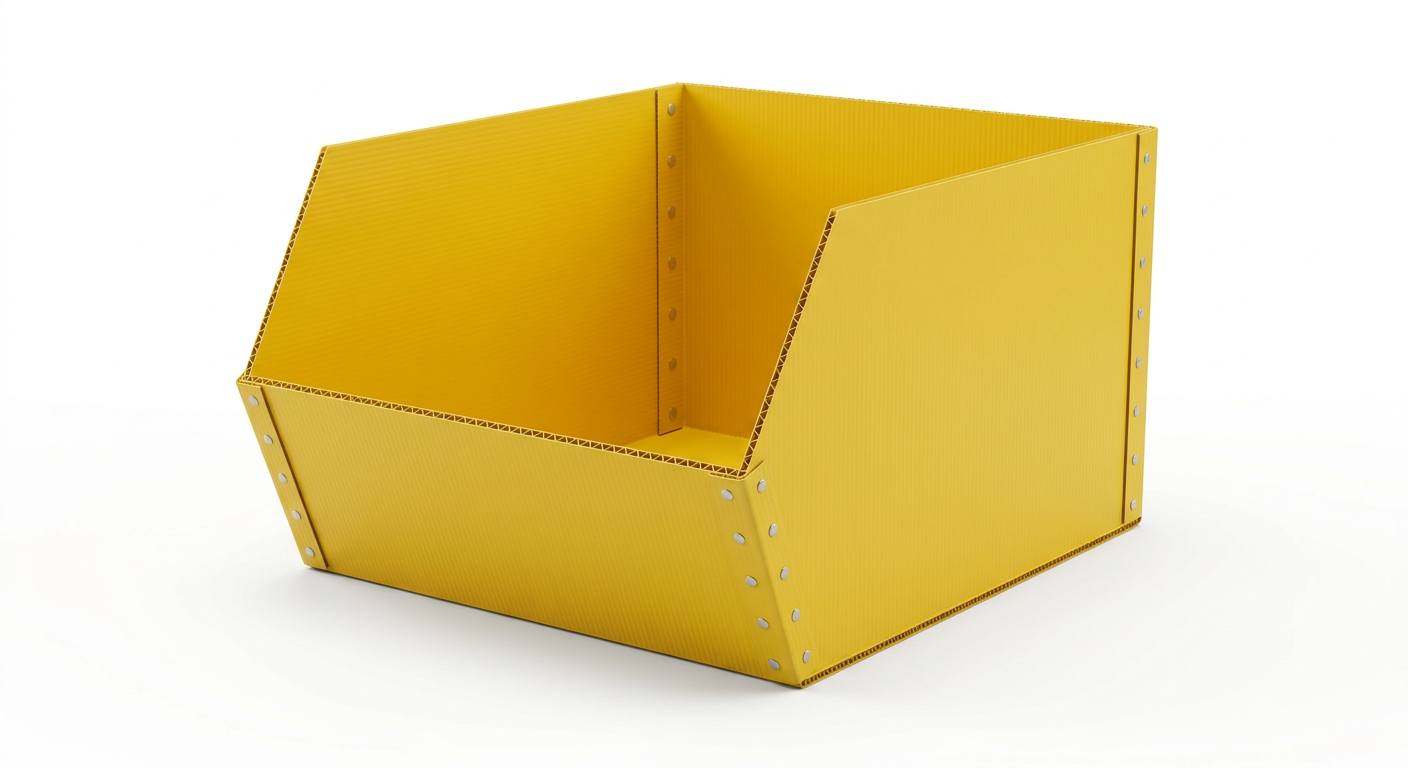
PP foldable boxes are particularly well-suited to automotive: they can be customised with foam inserts or dividers to protect machined components from scratching, they are chemical resistant (oil and coolant splash are constants in a machining environment), and they are easily identifiable with printed part numbers and barcodes.
Electronics and Pharma: The Next Wave
After automotive, the electronics manufacturing sector is showing the highest growth in PP corrugated adoption. PCB assembly lines need ESD-safe packaging — a requirement that cardboard cannot meet. Anti-static PP corrugated (ESD packaging) fills this gap, with surface resistivity in the 10⁶–10⁹ Ohm range that protects sensitive components from electrostatic discharge. As India's electronics manufacturing base expands under the PLI scheme, this segment is expected to grow rapidly.
Pharmaceutical companies are also beginning to adopt PP corrugated for internal WIP (work-in-progress) movement — the transit of partially assembled products between production departments. The hygiene advantage (PP can be wiped clean with IPA or standard sanitisers) and moisture resistance (critical in humidity-controlled pharma environments) make PP corrugated a compelling choice for GMP-compliant facilities.
The Sustainability Angle
PP corrugated returnable packaging reduces packaging waste significantly. A closed-loop system with 500-trip PP boxes eliminates approximately 498 corrugated boxes that would otherwise have been purchased, used once, and sent to waste. For manufacturers with ESG reporting requirements — increasingly common for export-facing businesses and publicly listed companies — this waste reduction is reportable as a direct contribution to Scope 3 emission reductions.
It's important to note that PP corrugated is not infinitely circular. At end-of-life, PP can be mechanically recycled, and several recyclers in India's major industrial clusters now accept PP corrugated for reprocessing. The sustainability case is strong but depends on a managed end-of-life process.
When Cardboard Still Makes Sense
- One-way or open-loop logistics: If packaging cannot be reliably returned, cardboard's lower per-unit cost wins.
- Irregular or seasonal products: Where volumes are too low to justify a custom PP mould or die-cut tool.
- Export packaging: Where packaging cannot be recovered (overseas shipments), corrugated is typically standard.
- Very large or very small sizes: Extreme dimensions in PP corrugated carry tool costs that may not be justified.
- Short shelf-life products: Where packaging is destroyed on opening, the reusability benefit is irrelevant.
The PP vs cardboard decision is not universal. It requires a trip-analysis, a volume assessment, and an evaluation of your logistics loop. Pune Global Group can help you model the economics for your specific application before you make any capital commitment.
Explore Related Products
Apply What You've Learned
Talk to Our Packaging Experts
Have a specific board or packaging question? We give honest, technical answers — no upselling. Reach our team at any time.